Wild Relatives: The imposing African buffalo
Editor’s note: Our Wild Relatives story series will explore the connections between our local wildlife species and related animals from around the globe. By learning about these exotic species, we hope to foster appreciation for the remarkable creatures that live in our backyards and neighborhoods.
The bison is the largest land animal we see here in North America. The same thing can't be said for the African buffalo. These buffalo are a close cousin of our North American bison. The African buffalo are large, but in a land where elephants and rhinoceroses also roam, they aren't the largest animal in Africa.

The African buffalo is one of two buffalo species in the world. The other is the water buffalo that is native to parts of Asia. African buffalo are divided into four distinct subspecies: Central African buffalo; forest buffalo; southern savanna buffalo, also known as Cape buffalo; and West African savanna buffalo. Cape buffalo are the most common.
In Africa, buffalo are part of the big five, a group of animals that also includes lions, leopards, elephants and rhinoceroses. This term at one time referred to the five most prized catches among 19th-century game hunters. Today, the term has changed to mean the five animals visitors would like to see on an African safari.
An imposing appearance
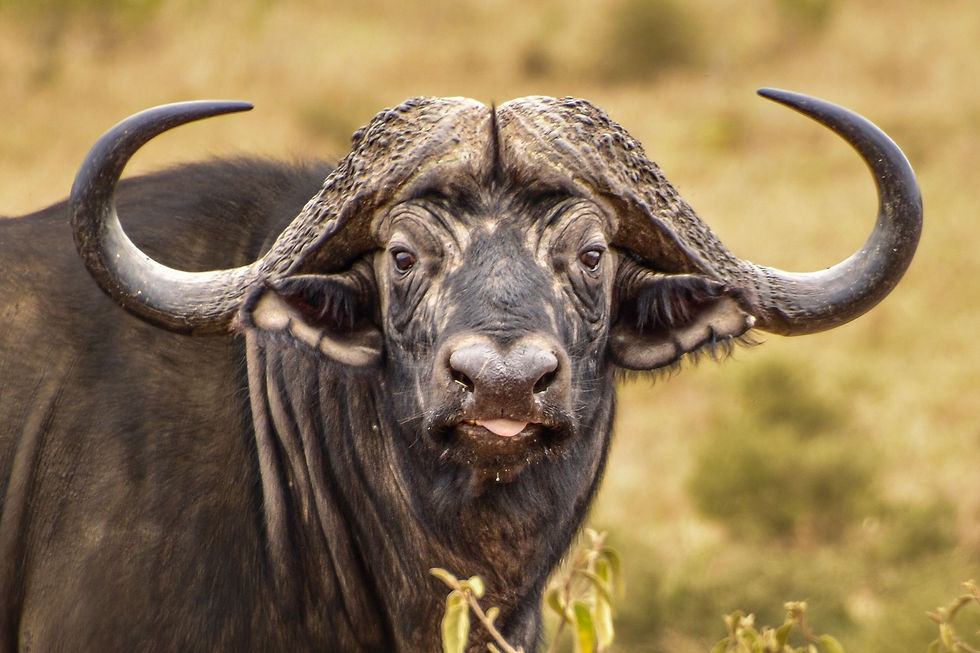
An African buffalo's size makes it hard to miss, but these animals' large curved horns give them a distinctive appearance. Both males and females have horns that grow downward and then curve upward. They are useful for a few reasons. First, they can be used to battle predators. They also use them to gain a greater position within the herd, and males use their horns in scuffles when they are fighting to show their dominance.
African buffalo stand 4 feet to 5 feet tall and can weigh between 660 and 1,800 pounds. Males are much larger than females. Their color can vary depending on the subspecies. Many are dark gray or black, but forest buffalo and some savanna buffalo have more reddish fur.
Many people use the terms buffalo and bison interchangeably, but they are separate and distinct species. One noticeable physical difference between them is that bison have beards, but buffalo do not.
Grazing giants
Like North American bison, African buffalo are grazers. They spend much of their time grazing on grasses and sedges. Buffalo will begin to deteriorate quickly if they don't have access to a lot of grazing land.
Words to know
Abundant: Existing in large quantities.
Deteriorate: To become progressively worse.
Distinctive: Characteristic of a person or thing that distinguishes it from others. Dominance: Power and influence over others.
Scuffle: A fight or struggle.
Wallow: To roll or lie about in mud or water.
These buffalo inhabit a variety of African habitat areas, including bushlands, savannas, grasslands and rainforests. Their main habitat requirement is that they are near a water source.
Like bison, they are social animals. They live in herds that can include hundreds of animals, but herds will sometimes join together to form masses of thousands. Gathering in large herds makes it easier for them to avoid being hunted by lions, leopards, wild dogs and other predators.
African buffalo spend time wallowing in mud, which can leave them with a reddish appearance. The mud helps them rid their skin of ticks, parasites and other pests. Birds will often hitch a ride on a buffalo's back, and this isn't just for a convenient way to travel from place to place. They will eat ticks and insects right off their backs.
Female African buffalo do not reproduce for the first time until they are four or five years old. They usually only have a calf every other year. Calves are typically born at the end of rainy season because this is when grass and other vegetation is most abundant.
Mothers stay very close to their calves, but the fathers do not play a role in raising them. The young buffalo nurse for about a year after they are born. Males will stay with their mother's herd for about four years before leaving to join a male herd. Females will stay with their mothers for their entire lives.
A declining population
Today, Africa is home to about 900,000 buffalo. About 75% of them live on protected land, in places like national parks and reserves. Their population is decreasing, and they are considered a near threatened species on the International Union for the Conservation of Nature (IUCN) Red List of Threatened Species.
Outside of protected areas, African buffalo can come into conflict with humans and are viewed as a threat. The buffalo can consume large amounts of crops, and they also break fences and have passed diseases to livestock populations.
The primary threat to the buffalo is habitat fragmentation caused by human development. Disease is also a factor. In the past, diseases have been introduced from outside areas with devastating effects on the bison population.


