Scarlet tanagers: A flash of red in the forest
Move over, cardinals. Our Illinois state bird isn't the only red bird in town.
If you spot a red bird that isn't a cardinal, it's likely a scarlet tanager.
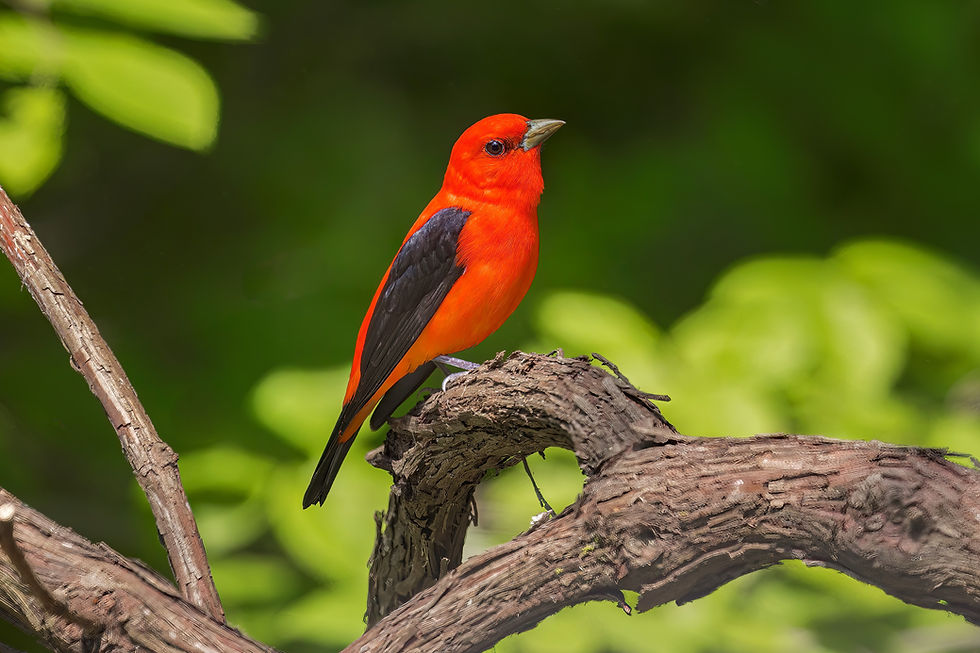
Male scarlet tanagers are a bright red color with black wings and tails. Like many songbirds, female scarlet tanagers aren't brightly colored. Instead, they are mostly olive green with brownish wings and tails.
In the fall, the males lose their bright red feathers and look similar in color to the females, but they keep their black wings and tails. Why the color change? Because those bright red feathers help the males attract a mate. Once breeding season is over, they don’t need to be brightly colored.
Scarlet tanagers are forest birds. For breeding, they typically look for big forested areas full of large trees. Despite their bright color, it can be hard to spot scarlet tanagers in the forest because they like to stay up high in the treetops.
A long journey
Scarlet tanagers are migratory, and their journey is a long one. In the summer, they can be found across most of the eastern United States and southern Canada. They spend their winters in the forests of northwestern South America. They migrate at night, and their journey includes a long flight over the Gulf of Mexico.
Words to know
Forage: To search widely for food.
Incubate: To sit on eggs to keep them warm and bring them to hatching.
Supplement: Something that completes or enhances something when added to it.
During spring and fall, you may see scarlet tanagers outside their preferred forested habitat. This is because they are looking for food to fuel them on their long journeys. During these periods, you might see them foraging in open spaces like parks and even in our yards.
Scarlet tanagers mostly eat insects, but they supplement their diet with fruit and some plant matter. They forage for food by moving across branches up high in the trees or moving up or down tree trunks. Among the insects they are looking for are beetles, butterflies, cicadas, dragonflies, flies, grasshoppers, leafhoppers and termites.
A not-so-sweet song?
Because they are hard to see in the trees, it's their song that usually gets our attention. Among songbirds, it's usually only the males that sing, but there are some exceptions, including scarlet tanagers (and their red relatives – cardinals).
While both male and female scarlet tanagers sing, males are louder and their songs are longer. Their song is often described as sounding like a robin with a cold or a sore throat.
Scarlet tanagers nest exactly where you think they would: high up in the trees. They will often pick spots at least 50 feet above the ground. That’s about as high as a five-story building!
The female will look for a shady spot and then build a shallow cup-shaped nest from grasses and twigs. She will lay between three and five bluish-green speckled eggs that she incubates herself. They will hatch about two weeks later.
The hatchlings are taken care of by both parents. The male will collect food and bring it to the female or feed the young birds directly. Within about two weeks, the young birds will fledge the nest.
Feathered relatives
Scarlet tanagers are part of the cardinal family of birds, which also includes buntings, grosbeaks and, of course, cardinals. Other tanagers native to North America include summer tanagers, western tanagers, hepatic tanagers and flame-colored tanagers.
Hepatic tanagers and flame-colored tanagers have small ranges in North America, mainly in Mexico and parts of the American southwest. The western tanager can be found across much of the western United States, but we don’t see it as far east as Illinois.
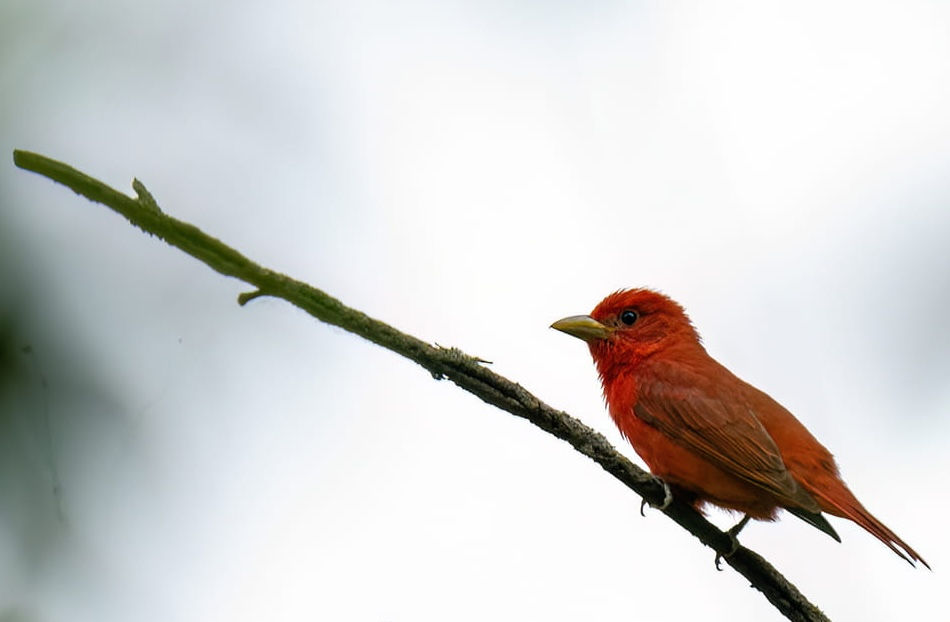
The summer tanager has a range that includes much of the southeastern and central United States. While parts of Illinois are included in its range, it is not often seen in the northeastern part of the state. The male summer tanager shares its red color with the scarlet tanager, but it is a lighter shade of red. And summer tanagers are entirely red, while scarlet tanagers have black wings and tails. Like scarlet tanagers, the female summer tanagers are more muted in color, mostly yellowish-green with darker wings and backs.


