Why do opossums play dead?
If you were a wild animal, how would you protect yourself? Rolling over and playing dead might not seem like the best protective strategy, but for some animals it's just right.
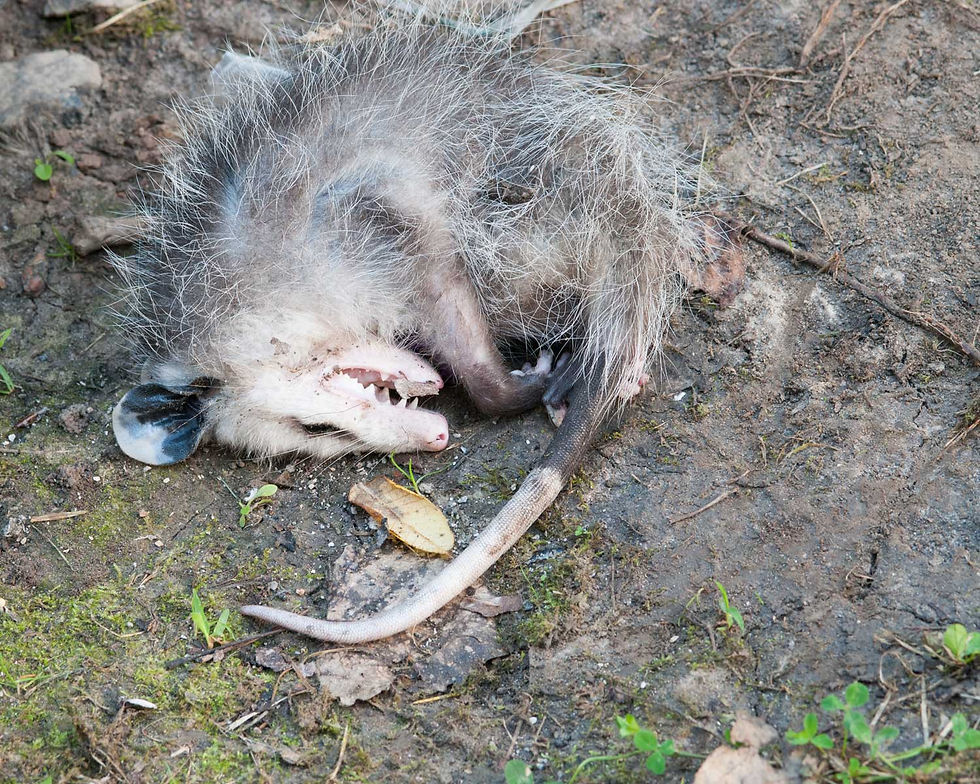
Opossums are the animal most known for playing dead, and their act is a convincing one. When they feel threatened, they will growl and hiss, but if they can't escape they will play dead.
The whole point of playing dead is to deter potential predators — bobcats, coyotes, foxes, raccoons, owls and more — from making them their next meal. To do this, they bare their teeth, foam at the mouth and release a foul-smelling secretion from their anal glands.
Words to know
Catatonic: In an immobile or unresponsive stupor.
Physiological: Related to the body and its systems.
Secretion: A process by which a substance is produced and discharged by an organism.
Opossums cannot control when they play dead. It happens automatically as a physiological response, much like fainting is in humans. If you come across an opossum that is playing dead, the best thing to do is leave it be. The catatonic state can last anywhere from a few minutes to a few hours, but the opossum will move along once it comes out of it.
Not just opossums
For opossums, playing dead is obviously an act of last resort, and while it is a well-known behavior, they don't do it very often. The practice is most common among younger opossums, while older animals will more likely stand their ground by hissing, baring their teeth or attempting to flee from a predator.
The scientific term for playing dead is thanatosis, and it's not as uncommon in the animal kingdom as you may think. In addition to opossums, some birds play dead. And even some fish and insects. In fact, thanatosis is most common among insects and other invertebrates.

Some snakes do as well. Even right here in Illinois there's a snake that is known to play dead. The eastern hognose snake, one of many snake species found in Illinois, will resort to thanatosis if necessary to avoid capture by a predator.
Like many others, a hognose snake will first attempt to scare off attackers in other ways. It will lunge at or even bite predators. If that isn't successful, the snake will do its version of playing possum, which involves inflating its body with air, rolling over and sticking out its tongue so it hangs limply from its mouth.
Other motives
While most animals that play dead do so to avoid capture by predators, a few, like the nursery web spider, have other motivations. Male nursery web spiders will play dead to attract a female mate. It makes sense when you consider that the female spiders often prey on the males.
To lure a female, a male nursery web spider will bundle up some food and attract the female to itself while pretending to be dead. When a female comes by and starts to eat the food, the male will spring to life and attempt to mate with her.
A behavior that might seem similar to thanatosis is one famously seen in fainting goats, but the two behaviors are actually quite different. While the goats are known as fainting goats, they aren't really fainting.
The "fainting" is actually from a genetic condition called myotonia congenita that causes their muscles to stiffen for a brief period when they are startled. This is why they are also called myotonic goats, as well as stiff leg goats and wooden leg goats. Like opossums when they play dead, the goats don't have any control over the behavior.


