This playlist is a hoot: Learn owls' songs
- Dec 16, 2025
- 4 min read
Updated: Dec 18, 2025
When it comes to the question of who lives in our forests and prairies, there are many answers. There are deer and squirrels and birds and insects and so many more animals they are too numerous to name. But if the question becomes whoooo lives in our forests and prairies, there is only one response. It’s owls!

Eight owl species call Will County home. Most live here all year long, but a few are only here in winter. They migrate to our area from locations farther north. And most of our local owls are nocturnal, so seeing them is a real treat. More often than not, we know owls are nearby because we hear them singing and calling.
Words to know
Abandoned: Having been deserted or cast off.
Deciduous: Shedding its leaves annually.
Depression: An area lower than the surrounding surface.
Mature: Fully grown and developed.
But owls don’t all sound the same. They don’t even all hoot. Each species has its own unique song. Becoming familiar with them can help you discern just whoooo might be nearby.
Learn more about the songs of our owl species and take a listen to their musical melodies.
Barn owl

Barn owls don’t call or sing so much as they screech or scream, and it’s a sound that many people might call blood-curdling. Their call would startle even the sturdiest among us if it suddenly broke the silence of the woods at night. Males are the primary callers, using their 2- or 3-second screams to signal to a female mate. Females call far less frequently.
Barn owls make their home in wide open spaces like grasslands, marshes, deserts, fields and suburbs and cities. They are cavity nesters and will set up a nest in tree cavities, caves and barns and other buildings during mating season.
Barred owl

Barred owls are famous for their song because they sound like they are calling out “Who cooks for you? Who cooks for you all?” This isn’t one of those cases where that’s what people say it sounds like but you have to have a pretty good imagination to hear it for yourself. It’s not that hard to hear those words when you listen closely. If you’re lucky enough, you may even hear a male and female pair calling back and forth to one another.
Barred owls are woodland birds, preferring mature forests of mixed trees near water. They aren’t migratory, and they are homebodies, staying close to their home territory. In one study of 158 barred owls, none had traveled more than 6 miles from their home base.
Eastern screech owl
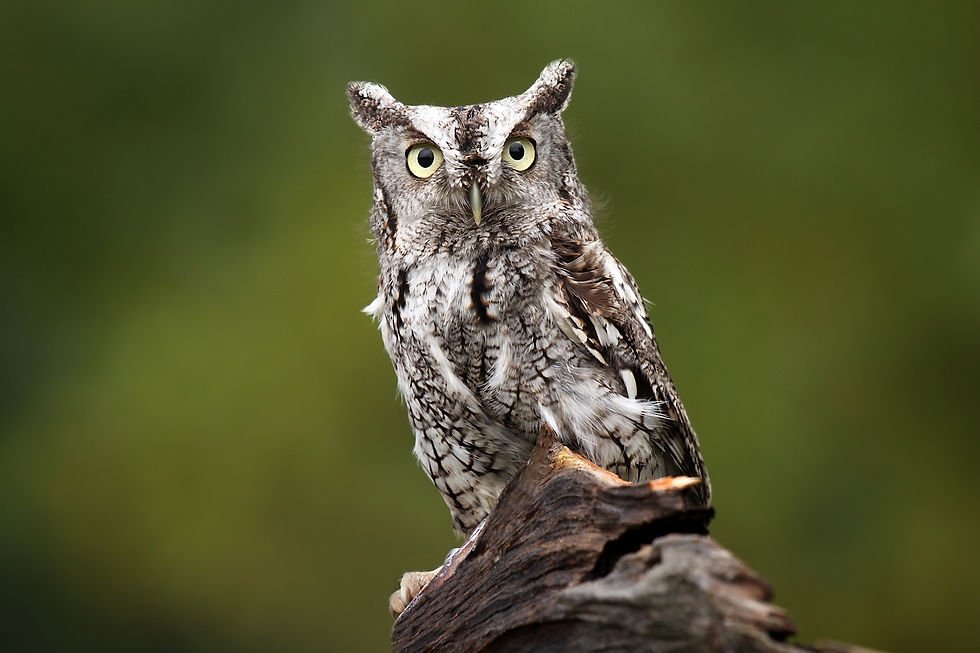
They don’t call these birds screech owls for nothing. Eastern screech owls do, in fact, make a high-pitched screeching song, but it’s not their only sound. They also make a sound that sounds a lot like a horse whinnying. Both male and female owls sing, and they will sometimes sing back and forth to each other.
Screech owls aren’t picky about where they live as long as there are enough trees nearby. It’s not unusual to find them living in parks, on farms and in cities and suburbs. They typically nest in tree cavities, but they will also move into nesting boxes.
Great horned owl

When you think of owls hooting in the night, it’s great horned owls that you hear in your head. They are the most famous hoot owl of all, singing out “hoo, h’hoo, hoo, hoo.” Both males and females sing, sometimes back and forth to one another, but females have a higher-pitched song than the males.
These birds are owls of the forest, but they will look for woodlands with open areas nearby. They nest in trees, but they will often take over an abandoned nest instead of building their own.
Long-eared owl

Long-eared owls are silent and secretive, but the males will sing out with a complex hooting song during mating season. The song consists of a series of evenly spaced whooo sounds, repeated anywhere from 10 to more than 200 times!
These owls are present in Illinois only in the winter, which means we aren’t lucky enough to hear their long songs locally. They typically spend their time in forests, and they are strictly nocturnal. During the day, they are difficult to spot thanks to their camouflage.
Northern saw-whet owl

Tiny northern saw-whet owls don’t exactly hoot; instead, they sing out with a song that sounds like too-too-too. The song is said to be similar to the sound of a whetting stone being used to sharpen a saw. Both males and females sing, but for different reasons. Males will sing out to mark their territory, while females will sing to attract a mate.
Like many owls, saw-whet owls are forest birds. They typically look for mature deciduous forests. During nesting season, they are less selective, building nests in tree cavities in many different kinds of woodlands or even nesting boxes if available.
Short-eared owl

Short-eared owls aren’t as vocal as many of our other owl species, but they will sing out with a series of hoots during courtship. It’s mostly the males that will sing, and they will do so both in flight and while perched.
Unlike most of our other local owl species, short-eared owls are not forest birds. They prefer grasslands like prairies and meadows and even agricultural areas. They are ground nesters. To make a nest, they will scrape a bowl-shaped depression into the soil that they line with feathers and grasses.
Snowy owl

Snowy owls are hooting owls, and both males and females will sing out with their low, throaty hooting song. You’ll usually hear them hoot in series of two, but occasionally they’ll add additional hoots, up to six at a time.
Snowy owls are another owl that is here locally only in the winter, and their numbers vary from year to year. They spend breeding season in the Arctic tundra. While here, they prefer open areas like prairies and farmland. Like short-eared owls, they build their nests on the ground.


