These insects build their own mobile homes
You’ve heard of the three little pigs that built their homes out of straw, sticks and bricks, but have you ever heard of the water bug that does the same?

This adorable little architect constructs a mobile home around its body using natural materials found in its habitat. Scientists named this fascinating creature the caddisfly.
Life cycle
Like butterflies and moths, caddisflies are born looking nothing like their winged adult selves. As adults, they have long, slender, soft bodies with three pairs of legs. Unlike butterflies and moths, their larvae live completely underwater. The larvae live and grow underwater for between a few months to a couple of years before building a silk cocoon and transforming into a winged adult.

Adult caddisflies can be identified by their four drab-colored wings and long, thin antennae. They hold their hairy wings in a tent-like shape when resting on plants near the water. Adults only live for a few weeks, just long enough to find a mate and lay more eggs in the water for the whole life cycle to begin again.
Mobile homes
Like spiders, caddisfly larvae can produce silk! The silk acts as a double-sided, waterproof tape. They use this sticky silk to glue together all sorts of natural items to form a case around their soft bodies. These materials include plant matter, pebbles, sand, twigs, pieces of wood, pine needles and sometimes even snail shells!
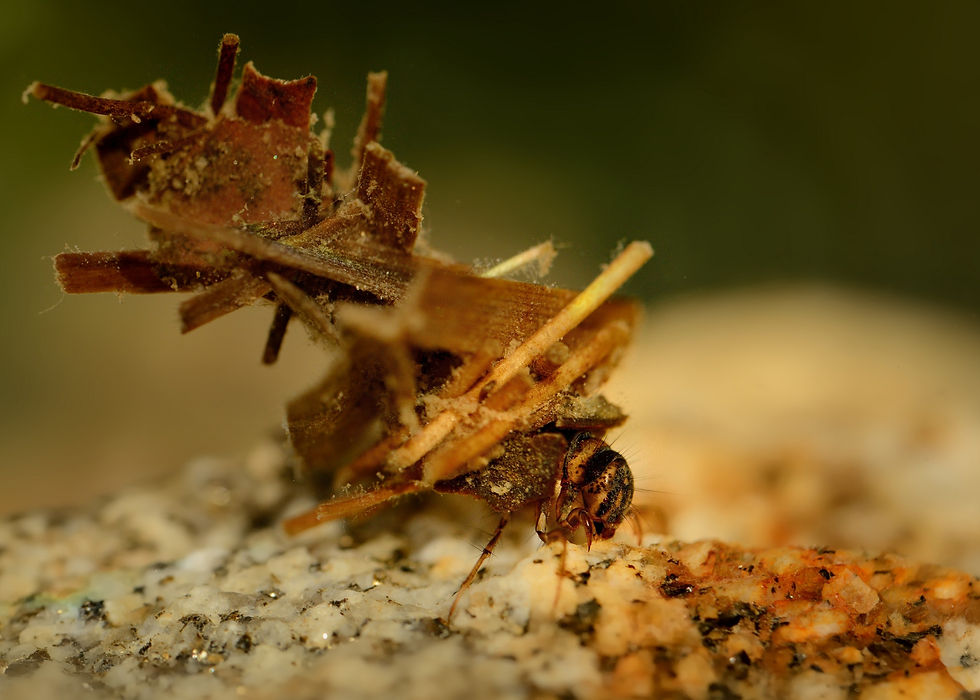
Larvae may be found in many different aquatic habitats, from still ponds to rapid rivers. Depending on where they are found and what materials are available, their cases may look very different.
In slow-moving waterways, the larvae may choose to use lighter materials like leaves, plant material and twigs. In a fast-paced waterway, they may choose to construct a stronger case using materials such as pebbles and small stones. These heftier materials provide extra weight and stability to prevent the bug from getting swept up or pushed around by the current.
They are not stuck in their mobile home. They can leave it if they choose. If they outgrow their case, they may start over completely or add to their existing one to make it bigger. The cases provide protective armor and great camouflage from predators.
Their role in nature
Caddisflies play a major role in the ecosystem, especially during their larval stage underwater. These little river bugs help cycle nutrients in the water by eating decaying plant material off the bottom of the waterway. Some caddisflies eat plants, some scrape algae off the rocks and others hunt for small bugs.
Words to know
Drab: Dull, lifeless or faded in appearance.
Hefty: Big and bulky.
Larva: The immature wingless form of an insect.
Slender: Small or narrow.
Swarm: A large number of things gathered together, usually in motion.
Most larvae are sensitive critters. They have a low tolerance for water pollution and sudden habitat changes. This makes thchaem perfect bioindicators, meaning scientists can monitor this bug to learn about the waterway's health.
At all stages of their life cycle, caddisflies are an excellent source of nutrition. Many animals higher in the food chain, such as fish, water bugs, birds, bats and spiders, find caddisflies to be a delicious snack.
Go explore!
Adult caddisflies are most active at dusk and dawn. Take a walk along a river in the early morning or late evening to spot these insects swarming around the water and even up by the streetlights. Gently peak under rocks and stones in a stream to see if you can spot one in a camouflaged case.
Remember that caddisflies are sensitive little bugs. Make sure to wash your hands of any bug spray or sunscreen before handling them and put them back where you found them!


