The secret underground life of pocket gophers
There's a whole world living right below our feet. Creatures big and small prefer to live their lives underground rather than up above. When we think of mammals that live their lives underground, moles, voles and woodchucks might come to mind first. A less well-known subterranean animal is the plains pocket gopher, the only gopher species that lives in Illinois.
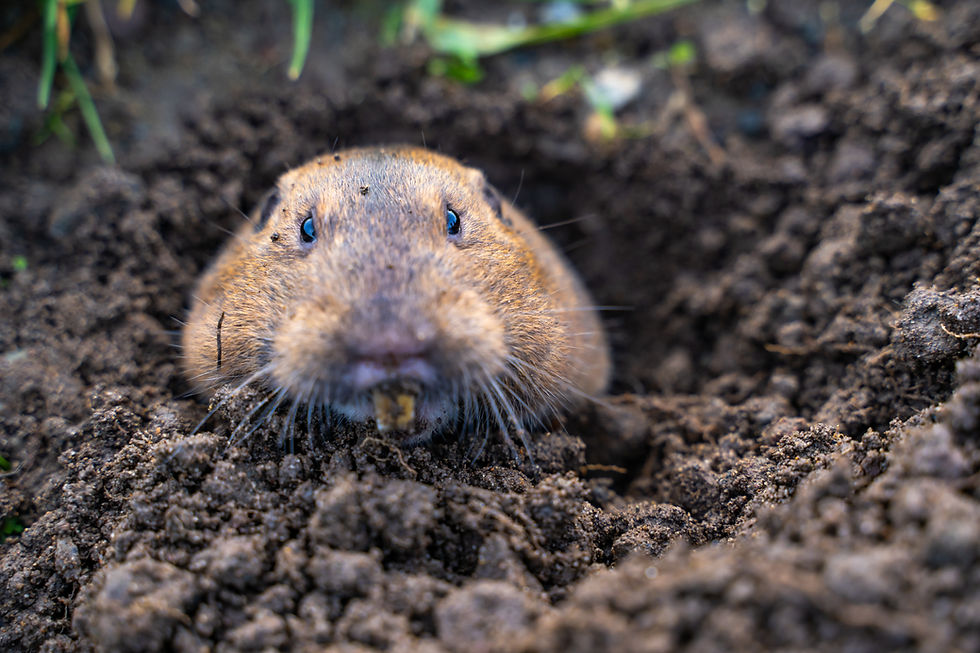
Plains pocket gophers are similar in size to a rat, but they are a little stockier. They can weigh up to 1 pound, and they have short, dark fur, ranging in color from brown to black. Their bellies are lighter than their backs. They have small eyes and ears and long tails that are mostly without fur.
On the rare instances when they are seen aboveground, pocket gophers are often mistaken for moles. The two animals look similar, but gophers are larger than moles.
A boon to the ecosystem
Plains pocket gophers like sandy soils. In Illinois, they are most common in the middle section of the state because that’s where sandy soil is more abundant. They are the most widespread gopher species across North America and live across most of the Great Plains.
Pocket gophers prefer sandy soils because they drain well, making life a little easier for these underground residents. As they tunnel through the soil, they help aerate it and also increase soil fertility, which is how they benefit the ecosystem.
Words to know
Aerate: To supply with oxygen.
Stocky: Compact, sturdy and relatively thick in build.
Subterranean: Lying or operating under the earth.
As they tunnel underground, they create burrows that can be as long as 500 feet, but they don't normally dig more than 3 feet below the surface. They often burrow in open areas like fields, cemeteries, golf courses and yards.
Plains pocket gophers leave signs of their activity, but they can often be confused with the signs left by the eastern mole. Both can create mounds of soil at the surface, but plains pocket gophers will create kidney- or fan-shaped mounds, while mole mounds are more round and volcano like. And gophers do not create tunnels at the surface like moles do.
Like other burrowing creatures, plains pocket gophers are built for their digging lifestyle. They have long, curved front claws that help them dig quickly, and their whiskers and tails are both sensitive, which help them navigate. They can also close their lips behind their teeth, which allows them to dig with their teeth without getting soil in their mouths.
Underground herbivores
Pocket gophers are herbivores. They mostly eat underground, although they may occasionally munch on some plant life while aboveground. Because they mostly eat while down below, their primary food sources are roots and tubers from a variety of plants.
Gophers are rodents, and like all rodents, their front teeth never stop growing. This helps with their vegetarian lifestyle because it prevents their teeth from getting too worn down from always gnawing on hard plant roots. Their flat molars also help them as they eat because they grind up the vegetation. Gophers don't always eat as they go, however. They have pockets on the outside of their cheeks where they can store food as they move through their burrows.
Plains pocket gophers are solitary and spend most of their time alone. They are territorial and will defend their burrows from other gophers who intrude.
In Illinois, breeding can begin as early as January and continues through spring. Females will have one litter each year, typically with three or four babies. The babies are called pups. The females will care for the pups for five or six weeks. Then the pups will stick close to the burrow for a few more weeks before leaving to establish their own territories.
Property problems

Because they are diggers, plains pocket gophers can sometimes cause problems around homes and farms because they can damage yards and lawns. This is another trait they share with moles.
Making soil more compact or installing wire barriers are two ways property owners can prevent damage in their yards.


